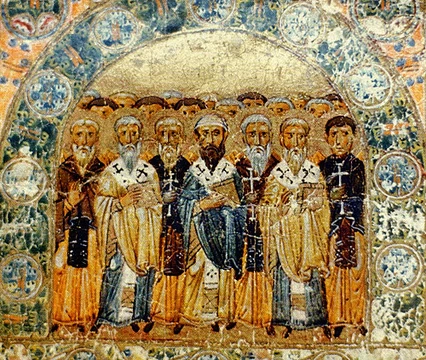
Matthew the Apostle
Apostle, tax collector turned evangelist, author of the first Gospel.

Matthew the Apostle was one of the twelve apostles of Jesus. According to many Christian traditions, he was also one of the four Evangelists as author of the Gospel of Matthew, and thus is also known as Matthew the Evangelist. The New Testament records that as an Apostle, he followed Jesus. Church Fathers, such as Irenaeus and Clement of Alexandria, relate that Matthew preached the gospel in Judea before going to other countries.
- Known for
- Apostle, Evangelist, author of the Gospel of Matthew
- Also known as
- Matthew the Evangelist, Levi
- Father
- Alphaeus
- Feast days
- September 21 (Catholic, Lutheran, Anglican); June 30/July 13 and November 16/29 (Eastern Orthodox)
- Venerated in
- Roman Catholic, Eastern Orthodox, Lutheran, Anglican churches
- Tomb
- Crypt of Salerno Cathedral, Italy
Lore & Background
Matthew is mentioned in Matthew 9:9 and Matthew 10:3 as a tax collector who, while sitting at the 'receipt of custom' in Capernaum, was called to follow Jesus. He is also listed among the Twelve Disciples in Mark 3:18, Luke 6:15 and Acts 1:13. In passages parallel to Matthew 9:9, both Mark 2:14 and Luke 5:27 describe Jesus's calling of the tax collector Levi, the son of Alphaeus. Since the father of both Matthew (known as Levi) and James, son of Alphaeus is named Alphaeus, according to the tradition of the Eastern Orthodox Church the two apostles were brothers. After Jesus' ascension, the disciples withdrew to an upper room (Acts 1:10–14) in Jerusalem. Early Church Fathers such as Irenaeus and Clement of Alexandria say that Matthew preached the gospel to the Jewish community in Judea, before going to other countries. Ancient writers are not in agreement as to which other countries these are, but almost all sources mention Ethiopia. The Catholic Church and the Orthodox Church each hold the tradition that Matthew died as a martyr. According to some traditions, while preaching in Ethiopia, Matthew converted Ephigenia of Ethiopia, the virgin daughter of King Egippus. When King Hirtacus succeeded Egippus, he asked the apostle to persuade Ephigenia to marry him. Matthew rebuked the king, who then ordered his bodyguard to kill Matthew at the altar, making him a martyr.
Reader's Guide
Matthew the Apostle holds a central place in Christian tradition as both one of the twelve apostles and the attributed author of the Gospel of Matthew, the first book of the New Testament. His calling from a tax collector—a profession often despised in Jewish society—to a disciple of Jesus illustrates a theme of transformation and inclusion. Early Church tradition, attested by Papias of Hierapolis and Origen, held that Matthew wrote his gospel in Hebrew near Jerusalem for Hebrew Christians, though most modern scholars consider the gospel anonymous and written in Greek. The tradition of Matthew's authorship, however, still has defenders. Matthew's missionary work, according to Church Fathers, began in Judea and extended to other countries, with Ethiopia (likely the region south of the Caspian Sea) frequently mentioned. His martyrdom is affirmed by Catholic and Orthodox tradition, with the Babylonian Talmud also appearing to report his execution. In art, Matthew is often depicted with a winged man, one of the four living creatures of Revelation. His feast is celebrated on September 21 in Western churches and on multiple dates in Eastern Orthodoxy. Beyond Christianity, Matthew is recognized as a prophet in the Druze faith and is named among Jesus' disciples in Muslim exegesis. His tomb in Salerno Cathedral remains a site of veneration.
Did You Know?
- Matthew is also known as Levi, the son of Alphaeus, in the Gospels of Mark and Luke.
- According to the Eastern Orthodox tradition, Matthew and James, son of Alphaeus, were brothers.
- The Babylonian Talmud (Sanhedrin 43a) names 'Mattai' as one of five disciples of 'Jeshu' and appears to report his execution.
- In the Druze faith, Matthew the Apostle is honored as a prophet, one of five great prophets of the first century.
More in Christian Saints & Early Church Fathers 1-24
Elsewhere in the Christian Saints & Early Church Fathers universe
Spotted an error? Know more?
This is a living reference — every entry is fact-audited, and reader corrections feed straight into our audit queue. Suggest an edit · See this site's audit record