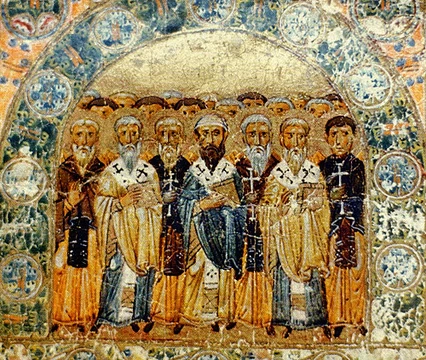
Pope Honorius I
Pope condemned posthumously for Monothelite correspondence.

via Wikipedia: Pope Honorius I · see source
Pope Honorius I was the bishop of Rome from his consecration on 27 October 625 until his death on 12 October 638. Born in Campania to a wealthy aristocratic family, his father Petronius held the honorary title of consul. He actively supported the Christianisation of the Anglo-Saxons, sending Saint Birinus to convert the West Saxons and bestowing the pallium on the archbishops of York and Canterbury. He also worked to persuade the Irish and British churches to adopt the Roman Easter computus. Honorius is most noted for his correspondence with Patriarch Sergius I of Constantinople concerning the Monoenergism controversy and the associated Monothelite doctrines. He was posthumously anathematized by the Third Council of Constantinople in 681 for following the Monothelites and confirming their doctrines, a condemnation confirmed by Pope Leo II. This anathema became a primary argument for opponents of papal infallibility during the First Vatican Council in 1870.
- born
- Campania
- died
- 12 October 638
- field
- Pope, Bishop of Rome
- nationality
- Roman (Campania)
- known_for
- Correspondence with Sergius I, anathematization for Monothelitism, role in papal
Lore & Background
Honorius I was a wealthy aristocrat born in Campania, son of Petronius, who held the honorary title of consul. Little is known about his life before he was elected pope on 27 October 625, two days after the death of his predecessor Boniface V. The short vacancy is attributed to the presence in Rome of Isaac the Armenian, the imperial exarch of Italy, who could confirm the election. As pope, Honorius modeled his papacy after Gregory I and employed monks rather than secular clergy in the administration of the Lateran Palace. He supported Adaloald, the deposed Catholic king of the Lombards, but established diplomatic relations with Adaloald's Arian rival, Arioald. He attempted to appease the archbishops of Ravenna, who were dissatisfied with their subordination to Rome. Honorius actively supported the Christianisation of Anglo-Saxon England, sending Birinus to convert the West Saxons, but was less successful in convincing the Celtic clergy to abandon their divergent Paschal cycle. At the Sixth Council of Toledo, he urged the Visigothic bishops to persevere in their policies regarding the Jews, referencing precedents set by Gregory I. Patriarch Sergius I of Constantinople wrote to Honorius regarding the Monoenergism controversy, asking him to endorse a policy of silence. Honorius's reply in 635 endorsed the view that discussions over energies should cease. He agreed that Jesus does not have two conflicting wills, but one will, reasoning that Jesus did not assume the 'vitiated' human nature tainted by Adam's fall, but human nature as it existed prior to the fall. His secretary and scribe, Abbot John Symponus, later testified that the text referred to the human will alone, stating: 'When we spoke of a single will in the Lord, we did not have in view His double nature, divine and human, but His humanity only.' Pope John IV defended Honorius by stating he spoke 'only of the human and not also of the divine nature' when using the phrase 'one will.' St. Maximus the Confessor also defended Honorius's orthodoxy. The Venerable Bede described Honorius as a holy pastor, a characterization later cited by theologians such as Robert Bellarmine. Honorius became aware of the rise of Islam and viewed its tenets as closely resembling those of the Arian heresy.
Reader's Guide
Honorius I's legacy is dominated by his condemnation at the Third Council of Constantinople. In the XIII session on 28 March 681, the monothelites were anathematized by name, 'and with them Honorius, who was Bishop of Rome, as having followed them in all things.' Citing his written correspondence with Sergius, Honorius was accused of having confirmed impious doctrines. The XVI session reaffirmed the condemnation, explicitly stating, 'To Honorius, the heretic, anathema!' The XVII session on 16 September 681 decreed that Honorius had 'with unheard of expressions disseminated amidst the faithful people the heresy of the one will,' doing so 'in agreement with the insane false doctrine of the impious Apollinaris, Severus and Themistius.' The Roman legates made no objection. Pope Leo II's letter of confirmation commended the council and stated: 'We anathematize the inventors of the new error, that is, Theodore, Bishop of Pharan, Sergius, Pyrrhus, Paul, and Peter, betrayers rather than leaders of the Church of Constantinople, and also Honorius, who did not attempt to sanctify this Apostolic Church with the teaching of apostolic tradition, but by profane treachery permitted its purity to be polluted.' Within the year, a Latin translation of the Acts was disseminated and signed by bishops throughout the West. The condemnation was reiterated by Pope Leo's successors and subsequent councils, and was included in the Roman Breviary lessons for the Feast of St. Leo II until the eighteenth century. During the First Vatican Council of 1870, opponents of papal infallibility cited Honorius's case as a primary argument. Later attempts at rehabilitation argued that Honorius was not a 'formal heretic' but only a 'material heretic' or negligent. J. B. Bury argues the most reasonable conclusion is that Honorius did not really apprehend the point at issue, considering it more a question of grammar than theology. Louis Nazaire Bégin argued that Honorius confessed Catholic truth in his letters and only rejected new words used to express it for reasons of prudence. He concluded Honorius was condemned 'not for having taught error, but solely for not having exercised the necessary vigor in his duties as Head of the Church.'
Did You Know?
- Honorius I was consecrated pope on 27 October 625, only two days after the death of his predecessor Boniface V.
- His father Petronius held the honorary title of consul.
- Honorius sent Saint Birinus to convert the West Saxons and bestowed the pallium on the archbishops of York and Canterbury.
- The Third Council of Constantinople in 681 anathematized Honorius by name, stating he had 'followed them in all things.'
- Pope Leo II confirmed the condemnation, charging Honorius with failing to 'sanctify this Apostolic Church with the teaching of apostolic tradition.'
Frequently Asked Questions
Who is Pope Honorius I?
Pope Honorius I was a Roman from Campania who served as Bishop of Rome from his consecration on 27 October 625 until his death on 12 October 638. He is best remembered for his involvement in the Monothelite Christological dispute and for championing the spread of Christianity among the Anglo-Saxons.
What is Pope Honorius I most known for?
He is chiefly known for his written exchanges with Patriarch Sergius I of Constantinople, in which he appeared to endorse the Monothelite position that Christ possessed only one operative energy. He also actively supported the missionary effort to bring the Anglo-Saxon peoples into the Christian fold.
How does Pope Honorius I's story end?
Honorius died in 638 and was initially buried with the honors due a pope. However, the Third Council of Constantinople later condemned him posthumously, declaring his letters on Monothelitism heretical and anathematizing his name.
Why is Pope Honorius I important to church history?
His posthumous condemnation became the most frequently cited counter-example to the doctrine of papal infallibility, and it was central to the debates at the First Vatican Council in the 1860s. Critics argued that if a pope could be declared a heretic after death, the claim that every pope is preserved from error in matters of faith could not hold.
What was the Monothelite controversy involving Pope Honorius I?
The dispute centered on whether Christ had one or two wills (or energies) after the union of divine and human natures. Honorius's letters to Sergius I seemed to affirm the Monothelite formulation, which the Third Council of Constantinople (680–681) later defined as heretical, leading to Honorius's posthumous anathema.
More in Christian Saints & Early Church Fathers 25-37
Elsewhere in the Christian Saints & Early Church Fathers universe
Spotted an error? Know more?
This is a living reference — every entry is fact-audited, and reader corrections feed straight into our audit queue. Suggest an edit · See this site's audit record