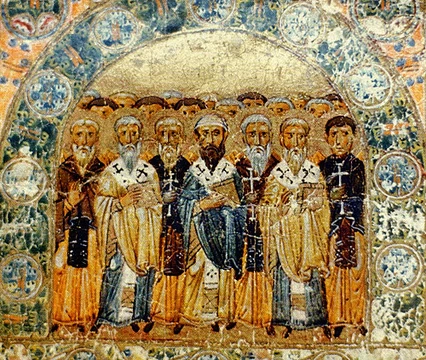
Pope Gregory I
64th Bishop of Rome, reformer, and Church Father.

via Wikipedia: Pope Gregory I · see source
Pope Gregory I (c. 540 – 12 March 604), commonly known as Saint Gregory the Great, was the 64th Bishop of Rome from 3 September 590 until his death. A Roman senator's son and himself the prefect of Rome at 30, Gregory lived in a monastery that he established on his family estate before becoming a papal ambassador and then pope. During his papacy, his administration greatly surpassed that of the emperors Maurice and Theodosius in improving the welfare of the people of Rome. He regained papal authority in Spain and France and sent missionaries to England, including Augustine of Canterbury and Paulinus of York. He is one of the four Great Latin Church Fathers and is known for his prolific writings and liturgical reforms.
- born
- c. 540 in Rome
- died
- 12 March 604
- field
- Pope, Church Father, Liturgical Reformer
- nationality
- Roman (Eastern Roman Empire)
- known_for
- Gregorian mission to England, Dialogues, revision of Roman worship, one of the f
Lore & Background
Gregory was born c. 540 in Rome into a wealthy noble family with close connections to the church. His father Gordianus, a patrician who served as a senator and for a time was the Prefect of the City of Rome, also held the position of Regionarius in the church. His mother Silvia was well-born, and both she and two paternal aunts, Trasilla and Emiliana, are honored as saints. Gregory's great-great-grandfather had been Pope Felix III. The family owned a villa suburbana on the Clivus Scauri on the Caelian Hill. Gregory was well educated, learning grammar, rhetoric, the sciences, literature, and law; he excelled in all these fields. Gregory of Tours reported that 'in grammar, dialectic and rhetoric ... he was second to none'. He became a government official, advancing quickly to become Prefect of Rome at only thirty-three years old. On his father's death, Gregory converted his family villa into a monastery dedicated to Andrew the Apostle. He was ordained a deacon by Pope Pelagius II and served as apocrisiarius (ambassador to the imperial court in Constantinople) from 579 to 586, seeking military aid against the Lombards.
Reader's Guide
Pope Gregory I's significance lies in his administrative, missionary, and literary achievements. During his papacy, his administration greatly surpassed that of the emperors Maurice and Theodosius in improving the welfare of the people of Rome. He regained papal authority in Spain and France and sent missionaries to England, including Augustine of Canterbury and Paulinus of York. The realignment of barbarian allegiance to Rome from their Arian Christian alliances shaped medieval Europe; Gregory saw Franks, Lombards, and Visigoths align with Rome in religion. He also combated the Donatist heresy, popular particularly in North Africa at the time. Gregory's writings were more prolific than those of any of the previous popes. The epithet 'Saint Gregory the Dialogist' has been attached to him in Eastern Christianity because of his Dialogues. Throughout the Middle Ages, he was known as 'the Father of Christian Worship' because of his exceptional efforts in revising the Roman worship of his day. His contributions to the development of the Divine Liturgy of the Presanctified Gifts, still in use in the Byzantine Rite, were so significant that he is generally recognized as its de facto author. Immediately after his death, Gregory was canonized by popular acclaim. He is the second of the three Popes listed in the Annuario Pontificio with the title 'the Great', alongside Popes Leo I and Nicholas I.
Did You Know?
- Gregory's great-great-grandfather had been Pope Felix III.
- Gregory was prefect of Rome at age thirty-three, the highest civil office in the city.
- Gregory of Tours reported that 'in grammar, dialectic and rhetoric ... he was second to none'.
- Gregory's mother Silvia and two paternal aunts, Trasilla and Emiliana, are honored as saints.
- Gregory is the second of only three popes listed in the Annuario Pontificio with the title 'the Great'.
Frequently Asked Questions
Who is Pope Gregory I?
Pope Gregory I, widely known as Saint Gregory the Great, held the see of Rome as its 64th bishop from 590 until 604. Before ascending to the papacy he lived as a Benedictine monk and served as a papal ambassador in Constantinople.
What are Pope Gregory I's most notable achievements?
He is best remembered for dispatching the monk Augustine and a small band of companions to evangelize the Anglo-Saxons of England, a mission that still carries his name. He also overhauled Roman liturgical practice and reasserted papal authority across Spain and France during a period of political instability.
Why is Pope Gregory I counted among the four Great Latin Church Fathers?
His extensive theological writings, particularly the Dialogues and his extensive commentary on the Psalms, profoundly shaped Western doctrine and monastic spirituality for centuries. The Church formally placed his doctrinal authority alongside Ambrose, Jerome, and Augustine.
How did Pope Gregory I's papacy end?
He died in Rome on 12 March 604 after a prolonged illness, having shepherded the city through plague, famine, and political crisis. In his final months he remained focused on the material welfare of Rome's poor and the institutional stability of the Church.
What was the Gregorian mission to England?
In 597 Gregory sent Augustine of Canterbury with a small group of monks to the kingdom of Kent to preach the Christian faith to the Anglo-Saxon population. The mission succeeded in converting King Æthelberht and established a lasting Christian foothold that eventually spread across England.
More in Christian Saints & Early Church Fathers 25-37
Elsewhere in the Christian Saints & Early Church Fathers universe
Spotted an error? Know more?
This is a living reference — every entry is fact-audited, and reader corrections feed straight into our audit queue. Suggest an edit · See this site's audit record