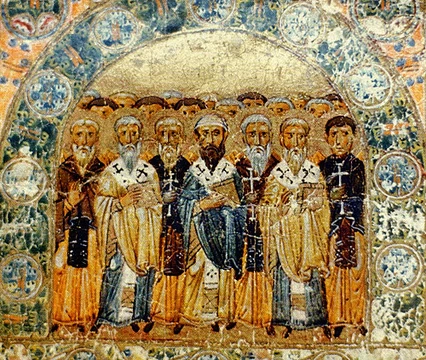
Pope Damasus I
Bishop of Rome who established the biblical canon.

via Wikipedia: Pope Damasus I · see source
Pope Damasus I (c. 305 – 11 December 384), also known as Damasus of Rome, was the bishop of Rome from October 366 to his death in 384. He presided over the Council of Rome of 382, which established the canon, or official list, of sacred scripture. Damasus spoke out against major heresies including Apollinarianism and Macedonianism, and encouraged production of the Vulgate Bible with his support for Jerome. He helped reconcile relations between the Church of Rome and the Church of Antioch, and encouraged the veneration of martyrs. He is recognized as a saint by the Catholic Church; his feast day is 11 December.
- born
- c. 305, possibly in Rome or Hispania
- died
- 11 December 384
- field
- Bishop of Rome (Pope)
- nationality
- Roman (possibly of Hispanic origin)
- known_for
- Presiding over the Council of Rome of 382, supporting the Vulgate, opposing here
Lore & Background
Pope Damasus I was either born in Rome or in Hispania around 305, before moving to Rome at a young age with his parents. His parents were Antonius, who became a priest at the Church of St. Lawrence in Rome, and his wife Laurentia, both originally from Lusitania. Damasus began his ecclesiastical career as a deacon in his father's church, later serving as a priest. He was archdeacon of the Roman church when Pope Liberius was banished by Emperor Constantius II to Berea in 354. Damasus followed Liberius into exile, though he immediately returned to Rome. During the period before Liberius' return, Damasus had a great share in the government of the church. Following the death of Pope Liberius on 24 September 366, Damasus succeeded to the Papacy amidst factional violence. The deacons and laity supported Liberius' deacon Ursinus, while the upper-class former partisans of Felix supported Damasus. J. N. D. Kelly states that Damasus hired a gang of thugs that stormed the Julian Basilica, carrying out a three-day massacre of the Ursinians. The prefects banished Ursinus to Gaul. Another ancient narrative, the 'Gesta' dated to 368 AD, records that an armed force instigated by Damasus broke into the Basilica of Julius and a three-day slaughtering took place. Damasus then ordered an attack against the Liberian basilica, resulting in another massacre: 'They broke down the doors and set fire underneath it, then rushed in...and killed a hundred and sixty of the people inside, both men and women.' Damasus next sent a final assault against some Ursinian supporters who had fled to the cemetery of Saint Agnes, slaying many. At a synod in 378, Ursinus was condemned, and Damasus exonerated and declared the true pope. Damasus faced accusations of murder and adultery in his early years as pope; the accuracy of these claims has come into question, with some suggesting the accusations were motivated by the conflict with supporters of Arianism.
Reader's Guide
One of the important works of Pope Damasus was to preside in the Council of Rome of 382, which determined the canon or official list of Sacred Scripture. The Oxford Dictionary of the Christian Church states that a council probably held at Rome in 382 under Damasus gave a complete list of the canonical books of both the Old Testament and the New Testament, also known as the 'Gelasian Decree' because it was reproduced by Gelasius in 495, which is identical with the list given at Trent. American Catholic priest and historian William Jurgens stated that it is now almost universally accepted that parts one and two of the Decree of Damasus are authentic parts of the Acts of the Council of Rome of 382 AD. Damasus appointed Jerome of Stridon as his confidential secretary. Jerome spent three years (382–385) in Rome in close intercourse with Pope Damasus. Writing in 409, Jerome remarked: 'A great many years ago when I was helping Damasus, bishop of Rome with his ecclesiastical correspondence, and writing his answers to the questions referred to him by the councils of the east and west...' Damasus encouraged Jerome to revise the available Old Latin versions of the Bible into a more accurate Latin based on the Greek New Testament and the Septuagint, resulting in the Vulgate. In two Roman synods (368 and 369) he condemned Apollinarianism and Macedonianism, and sent legates to the First Council of Constantinople convoked in 381 to address these heresies. Damasus was the author of Latin verse. Alan Cameron describes his epitaph for a young girl called Projecta as 'a tissue of tags and clichés shakily strung together and barely squeezed into the meter'. Several images of 'DAMAS' in gold glass cups probably depict him and appear to be the first surviving contemporary images of a pope, though there is no real attempt at a likeness. 'Damas' appears with other figures, including a Florus who may be Projecta's father. It has been suggested that Damasus or another of the group commissioned and distributed these to friends or supporters, as part of a programme 'insistently inserting his episcopal presence in the Christian landscape'. His life coincided with the rise of Emperor Constantine I and the reunion and re-division of the Western and Eastern Roman Empires. The reign of Gratian, which coincided with Damasus' papacy, forms an important epoch in ecclesiastical history, since during that period (359–383), Catholic Christianity for the first time became dominant throughout the empire.
Did You Know?
- Damasus hired a gang of thugs that stormed the Julian Basilica, carrying out a three-day massacre of the Ursinians, according to J. N. D. Kelly.
- Several images of 'DAMAS' in gold glass cups are the first surviving contemporary images of a pope, though with no real attempt at a likeness.
- Alan Cameron described Damasus' epitaph for a young girl called Projecta as 'a tissue of tags and clichés shakily strung together and barely squeezed into the meter'.
- Damasus was exonerated and declared the true pope at a synod in 378, while his rival Ursinus was condemned.
Frequently Asked Questions
Who is Pope Damasus I?
Pope Damasus I (c. 305–384) served as Bishop of Rome from October 366 until his death in 384. He is remembered as a Roman pontiff of possibly Hispanic origin who played a pivotal role in shaping early Catholic doctrine and biblical scholarship.
What is Pope Damasus I best known for?
He is most celebrated for presiding over the Council of Rome in 382, which formalized the list of canonical books of Scripture, and for championing Jerome's translation work that became the Vulgate. His papacy also involved vigorous opposition to various heretical movements.
How did Pope Damasus I's story end?
Damasus I died on 11 December 384 in Rome, closing a papacy that had been plagued by factional violence and accusations of misconduct. His death did not resolve the political and theological tensions of his era, but his institutional contributions endured.
Why is Pope Damasus I important to early church history?
His role in establishing the official biblical canon at the 382 council gave the Church a standardized scriptural foundation that persists to this day. By backing Jerome's Vulgate project, he also shaped how Western Christians would read the Bible for centuries.
What was the Council of Rome of 382?
It was a synod convened and presided over by Pope Damasus I that produced the definitive list of books recognized as sacred Scripture for the Western Church. The council's decisions helped settle long-standing disputes over which texts belonged in the canon.
More in Christian Saints & Early Church Fathers 25-37
Elsewhere in the Christian Saints & Early Church Fathers universe
Spotted an error? Know more?
This is a living reference — every entry is fact-audited, and reader corrections feed straight into our audit queue. Suggest an edit · See this site's audit record